Home Composting System Design: Build a Better Backyard Compost System
Designing a home composting system starts with asking the right question. Most home composting advice begins by recommending a compost bin or tumbler, but the better question is how much compost your landscape actually needs and how to design a system that can supply it.
People usually ask:
“What compost bin should I buy?”
As a systems engineer, I look at it differently.
The better question is:
“How much compost does my property need, and what system will produce or supply that amount?”
However, a compost bin, tumbler, worm bin, or pile is not the system. It is only one component within the system. A well-designed home composting system should consider material flow, seasonal biomass generation, retention time, compost demand, and the final goal: building living soil.
Start With the End in Mind
In this article you’ll learn how to estimate your compost needs, calculate how much organic material your yard produces, size a home composting system, and understand where compost tumblers, compost piles, and vermicomposting each fit into an efficient backyard system.
Before choosing equipment, estimate how much compost your garden or landscape actually needs.
For this example, let’s assume a typical residential property:
| Property Area | Square Feet |
|---|---|
| Total lot size | 8,000 sq ft |
| House footprint | 2,000 sq ft |
| Concrete and hardscape | 1,000 sq ft |
| Landscape and garden area | 5,000 sq ft |
That gives us approximately 5,000 square feet of landscape and garden area.
Now we need an application rate.
For this example, we will use an initial compost application rate of:
15 cubic yards per acre
Since one acre equals 43,560 square feet, the conversion is:
15 cubic yards ÷ 43,560 square feet = 0.000344 cubic yards per square foot
For 5,000 square feet:
5,000 × 0.000344 = 1.72 cubic yards
So, the first-year compost requirement is approximately:
1.7 cubic yards of compost
That number is important because it gives the system a target.
Compost Demand Over Five Years
Initially, the first application is usually the largest because the goal is to build soil organic matter and improve soil structure. After that, the annual compost requirement can decrease as the soil system improves.
For this example, let’s assume the compost rate gradually decreases over three years to 50% of the original application rate.
| Year | Compost Application Rate | Compost Required for 5,000 sq ft |
|---|---|---|
| Year 1 | 15.0 cy/acre | 1.72 cy |
| Year 2 | 12.5 cy/acre | 1.43 cy |
| Year 3 | 10.0 cy/acre | 1.15 cy |
| Year 4 | 7.5 cy/acre | 0.86 cy |
| Year 5 | 7.5 cy/acre | 0.86 cy |
| Total | — | 6.02 cy |
As a result, over five years, this landscape would require approximately 6 cubic yards of compost.
The average annual compost requirement would be:
6.02 ÷ 5 = 1.20 cubic yards per year
This is where many home composting systems run into problems.
A small backyard compost tumbler may only produce 0.25 to 0.50 cubic yards of finished compost per year. That does not mean the tumbler has failed. It means the tumbler should be viewed as one part of a larger soil-building system.
Compost Demand vs. Compost Production
Let’s assume a home compost tumbler produces about 0.4 cubic yards of finished compost per year.
| Year | Compost Demand | Tumbler Production | Compost Deficit |
|---|---|---|---|
| Year 1 | 1.72 cy | 0.40 cy | 1.32 cy |
| Year 2 | 1.43 cy | 0.40 cy | 1.03 cy |
| Year 3 | 1.15 cy | 0.40 cy | 0.75 cy |
| Year 4 | 0.86 cy | 0.40 cy | 0.46 cy |
| Year 5 | 0.86 cy | 0.40 cy | 0.46 cy |
| Total | 6.02 cy | 2.00 cy | 4.02 cy |
As a result, over five years, the tumbler supplies about 2 cubic yards of compost and reduces the amount of purchased compost by roughly one-third.
That is a successful system contribution.
The goal is not necessarily to produce 100% of the compost on site. The goal is to understand the compost demand, determine how much can realistically be produced, and then design a system to close the gap.
Estimating Biomass Generation
Finished compost is not equal to the starting volume of raw organic material.
During composting, material shrinks as water is lost, carbon is released as carbon dioxide, and organic matter decomposes.
A simple planning assumption is:
To produce 1 cubic yard of finished compost, plan on 2 to 3 cubic yards of raw organic material.
So, if a tumbler produces 0.4 cubic yards of finished compost per year, it may require about:
1 cubic yard of raw biomass per year
This biomass may include:
- Food scraps
- Leaves
- Grass clippings
- Garden trimmings
- Spent plants
- Shredded cardboard
- Small woody material
However, biomass generation is seasonal. A backyard does not produce the same amount of organic material every month.
Seasonal Biomass Flow
Here is a simple example of seasonal biomass generation for a small backyard composting system:
| Month | Biomass Availability | Likely Materials | Estimated Raw Biomass |
|---|---|---|---|
| January | Low | Kitchen scraps, cardboard, paper | 0.05 cy |
| February | Low | Kitchen scraps, cardboard, paper | 0.05 cy |
| March | Moderate | Garden cleanup, weeds, kitchen scraps | 0.08 cy |
| April | Moderate | Spring weeds, trimmings, grass clippings | 0.10 cy |
| May | High | Grass clippings, garden waste, food scraps | 0.12 cy |
| June | High | Garden trimmings, food scraps, grass clippings | 0.12 cy |
| July | Moderate | Food scraps, spent plants, garden trimmings | 0.08 cy |
| August | Moderate | Food scraps, garden waste, crop residue | 0.08 cy |
| September | High | Garden cleanup, spent plants, crop residue | 0.12 cy |
| October | High | Leaves, garden cleanup, spent plants | 0.12 cy |
| November | Moderate | Leaves, kitchen scraps, dry browns | 0.06 cy |
| December | Low | Kitchen scraps, stored leaves, cardboard | 0.02 cy |
| Total | — | — | 1.00 cy |
This table shows why home composting systems should be designed around flow, not just total annual volume.
During slow months, a compost tumbler may handle the entire organic stream. During peak months, excess material may need to be routed to mulch, a green organics cart, or a larger composting area.
Designing for Peak Flow
A good system does not need to be designed for the absolute peak month. Designing for the peak can create oversized equipment that sits underused most of the year.
For this example, we will design the tumbler system for 75% of the maximum monthly biomass flow.
Peak monthly biomass flow:
0.12 cubic yards per month
Design flow:
0.12 × 75% = 0.09 cubic yards per month
Weekly design flow:
0.09 ÷ 4 = 0.0225 cubic yards per week
This gives us a practical system design basis.
| Month | Biomass Generated | Biomass per Week | Tumbler Capacity | Goes to Tumbler | Overflow to Green Cart, Mulch, or Compost System |
|---|---|---|---|---|---|
| January | 0.05 cy | 0.013 cy/wk | 0.09 cy | 0.05 cy | 0.00 cy |
| February | 0.05 cy | 0.013 cy/wk | 0.09 cy | 0.05 cy | 0.00 cy |
| March | 0.08 cy | 0.020 cy/wk | 0.09 cy | 0.08 cy | 0.00 cy |
| April | 0.10 cy | 0.025 cy/wk | 0.09 cy | 0.09 cy | 0.01 cy |
| May | 0.12 cy | 0.030 cy/wk | 0.09 cy | 0.09 cy | 0.03 cy |
| June | 0.12 cy | 0.030 cy/wk | 0.09 cy | 0.09 cy | 0.03 cy |
| July | 0.08 cy | 0.020 cy/wk | 0.09 cy | 0.08 cy | 0.00 cy |
| August | 0.08 cy | 0.020 cy/wk | 0.09 cy | 0.08 cy | 0.00 cy |
| September | 0.12 cy | 0.030 cy/wk | 0.09 cy | 0.09 cy | 0.03 cy |
| October | 0.12 cy | 0.030 cy/wk | 0.09 cy | 0.09 cy | 0.03 cy |
| November | 0.06 cy | 0.015 cy/wk | 0.09 cy | 0.06 cy | 0.00 cy |
| December | 0.02 cy | 0.005 cy/wk | 0.09 cy | 0.02 cy | 0.00 cy |
| Total | 1.00 cy | — | — | 0.87 cy | 0.13 cy |
This is the value of system design.
Instead of asking whether the tumbler is “big enough,” we define what role it plays in the system.
In this example, the tumbler processes most of the annual biomass stream. During peak months, excess material is diverted to another destination.
The Five Composting Process Phases
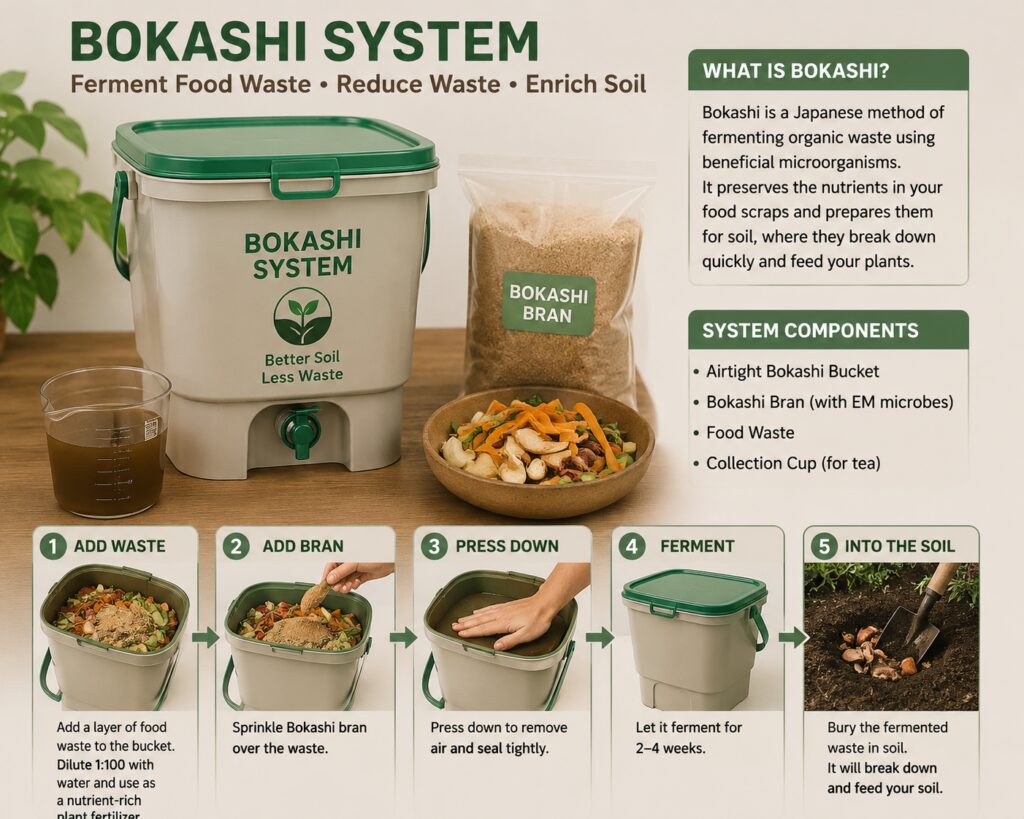
Next, a complete composting system can be divided into five process phases:
- Receiving
- Mixing
- Pathogen Reduction
- Active Composting
- Curing
Each phase requires enough capacity to hold material for a specific amount of time.
For this example, we will use the following retention times:
| Process Phase | Retention Time |
|---|---|
| Receiving | 2 weeks |
| Mixing | 1 week |
| Pathogen Reduction | 2 weeks |
| Active Composting | 4 weeks |
| Curing | 7 weeks |
| Total | 16 weeks |
Using the weekly design flow of 0.0225 cubic yards per week, we can estimate the required volume for each phase.
| Process Phase | Retention Time | Design Flow | Required Capacity |
|---|---|---|---|
| Receiving | 2 weeks | 0.0225 cy/wk | 0.045 cy |
| Mixing | 1 week | 0.0225 cy/wk | 0.023 cy |
| Pathogen Reduction | 2 weeks | 0.0225 cy/wk | 0.045 cy |
| Active Composting | 4 weeks | 0.0225 cy/wk | 0.090 cy |
| Curing | 7 weeks | 0.0225 cy/wk | 0.158 cy |
| Total System Volume | 16 weeks | — | 0.361 cy |
Rounded up, this system requires approximately:
0.4 cubic yards of total working capacity
This is a conservative estimate because it assumes no volume reduction between phases. In reality, compost volume decreases as the material decomposes. But for a beginner-friendly design example, this is a useful planning number.
A 100-Square-Foot Composting System
One of the most important conclusions from this exercise is that a practical backyard composting system does not require a large area.
A complete system can fit into a space as small as:
20 feet × 5 feet = 100 square feet
Example layout:
| Phase | Example Footprint |
|---|---|
| Receiving | 5 ft × 5 ft |
| Mixing | 3 ft × 5 ft |
| Pathogen Reduction | 3 ft × 5 ft |
| Active Composting | 4 ft × 5 ft |
| Curing | 5 ft × 5 ft |
| Total | 20 ft × 5 ft |
This layout is not meant to be the only design. It is a simple way to show that a composting system can be organized as a flow process.
Material enters one end of the system, moves through each phase, and eventually exits as finished compost or partially finished organic matter ready for soil building.
Where the Compost Tumbler Fits
However, a compost tumbler is often misunderstood.
Many homeowners expect a tumbler to be the entire composting system. That expectation often leads to disappointment.
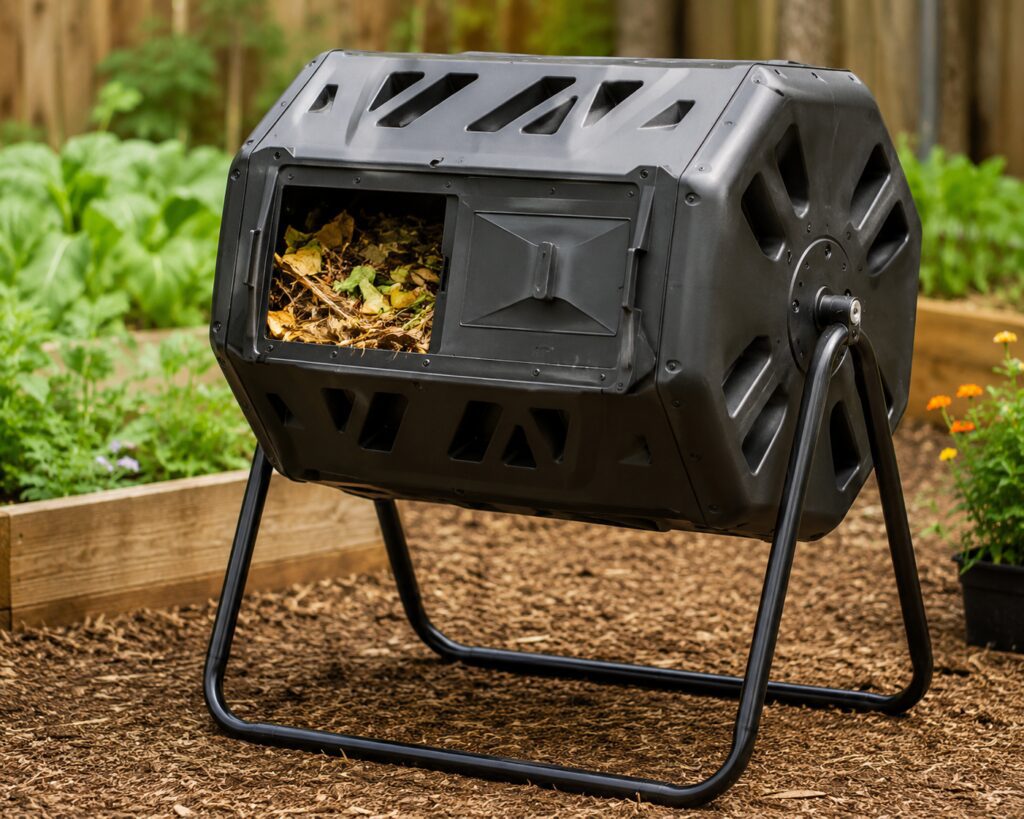
In a systems design, the tumbler may be assigned specific functions.
A tumbler is useful for:
- Mixing materials
- Controlling moisture
- Adding oxygen
- Heating material
- Supporting pathogen reduction
- Processing small, frequent organic inputs
A tumbler is not ideal for:
- Handling large seasonal biomass peaks
- Curing finished compost
- Storing large volumes of material
- Producing all compost needed by a landscape
In this system, the tumbler may perform the mixing and pathogen reduction phases. Active composting and curing may occur in another bin, pile, bed, or dedicated curing area.
That changes how we evaluate the tumbler.
The question is not:
“Can the tumbler produce all my compost?”
The better question is:
“What function does the tumbler perform within the system?”
Making an 80/20 Compost Blend at Home
This approach also creates an opportunity.
If the homeowner produces part of their compost on site and purchases the remaining compost, they can create a custom soil-building blend.
For example, the system may produce biologically active home compost from kitchen scraps, garden waste, and yard material. Purchased compost can provide the bulk volume needed to meet the landscape demand.
From there, worm castings or vermicompost can be added to create an 80/20 compost blend:
- 80% compost
- 20% vermicompost or worm castings
This is powerful because it gives the homeowner control over the quality and biology of the material being applied to the garden.
The compost provides organic matter and soil structure benefits.
The vermicompost contributes beneficial microbes, plant-available nutrients, and biological activity.
Together, they support the larger goal: building living soil.
The Future Vermicompost Phase
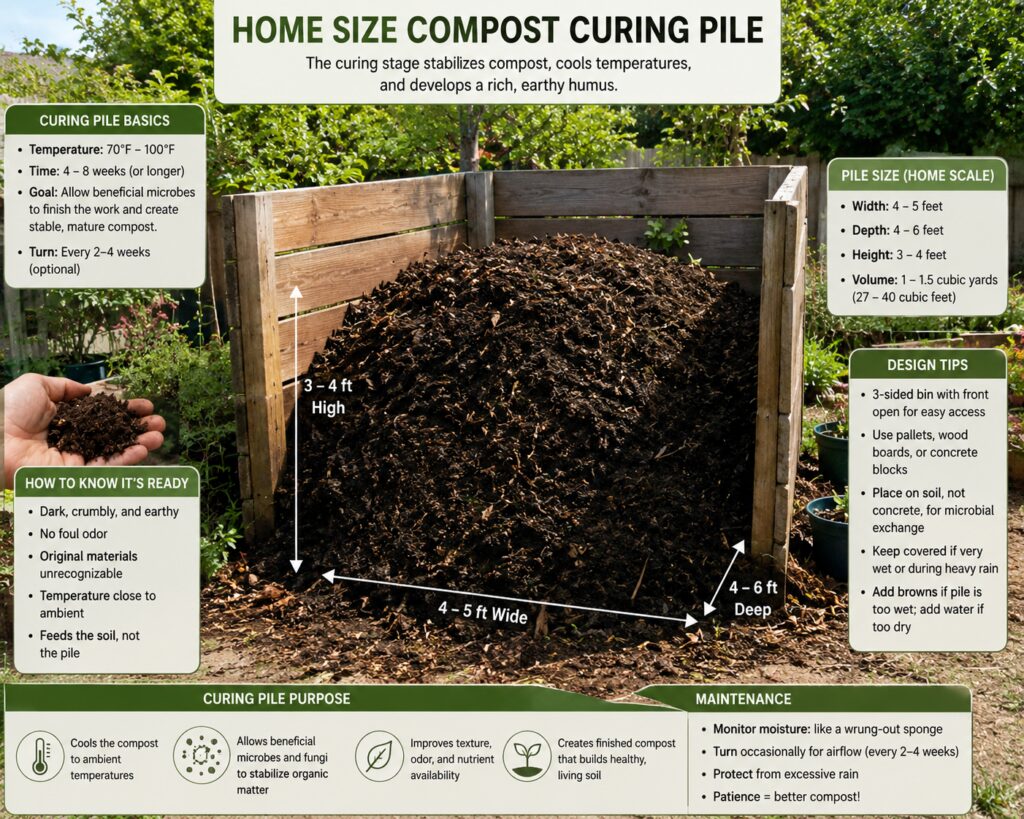
This article focuses on the composting side of the system.
A future system design could include a dedicated vermicomposting phase.
That phase would add another layer of biological processing and allow homeowners to convert selected organic materials into high-value vermicast or worm castings.
In a more advanced design, the home composting system and vermicomposting system would work together.
Composting handles bulk organic material and heat-based processing.
Vermicomposting refines selected materials into a biologically rich amendment.
Together, they create a complete backyard soil-building system.
The Role of Delta Worms
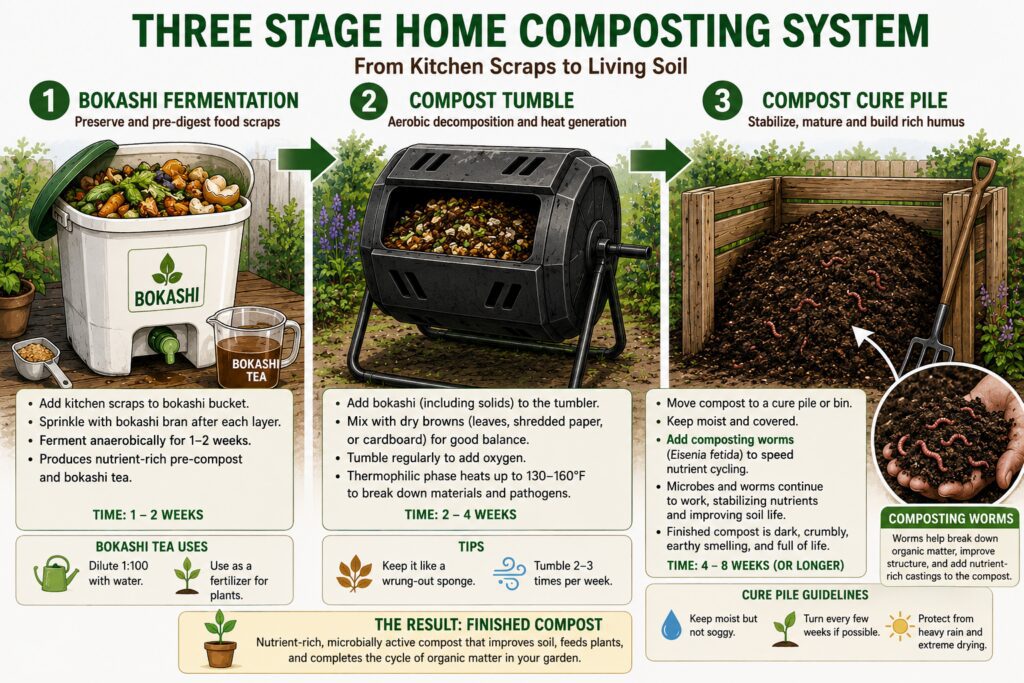
At Delta Worms, we see composting as more than waste reduction.
We see it as organic material flow management.
The same principles used to design a backyard composting system can also be applied to farms, nurseries, commercial facilities, municipalities, and industrial organic waste streams.
The scale changes, but the design questions remain the same:
- What material is generated?
- How much is generated?
- When is it generated?
- What processing steps are required?
- What is the desired end product?
- How much space is available?
- What role does biology play in the system?
Delta Worms helps homeowners, gardeners, farms, and facilities think through these questions and develop systems that turn organic residuals into soil-building resources.
Final Thoughts
A composting system is not a bin.
It is a process.
A well-designed home composting system starts with compost demand, estimates biomass generation, defines process phases, assigns retention times, and sizes each phase accordingly.
For a typical residential property, a compact 100-square-foot system can make a meaningful contribution to annual compost needs.
It may not produce every cubic yard required by the landscape, and that is okay.
The goal is not to prove that a tumbler or backyard system can do everything.
The goal is to design a practical system that recycles organic matter, supports soil biology, reduces waste, and helps build living soil.
Compost is not the end goal.
Living soil is the goal.
Compost is one of the tools we use to get there.
Editor’s Note: This article is the design guide for the Delta Worms Demonstration Composting System currently under construction at our Oakley, California property. As the project develops, concept illustrations will be replaced with photographs and performance data from the completed system.
Frequently Asked Questions
Can a compost tumbler produce all the compost my garden needs?
Sometimes, but often not. Most tumblers are better viewed as one component of a larger composting system. They can process kitchen scraps and small amounts of yard waste, but larger landscapes may still require purchased compost or additional composting capacity.
How much compost does a typical residential landscape need?
It depends on the size of the landscape and the application rate. In the example above, a 5,000-square-foot landscape requires about 1.7 cubic yards for the first application and about 6 cubic yards over five years.
Why design around biomass flow instead of just bin size?
Biomass is generated seasonally. A composting system must handle slow months and peak months differently. Designing around flow helps determine when material goes to the tumbler, mulch, green cart, or a larger composting system.
What does pathogen reduction mean in composting?
Pathogen reduction means creating composting conditions that reduce harmful organisms. In hot composting systems, this is often done by maintaining elevated temperatures for a sustained period of time.
Does curing really matter?
Yes. Curing allows compost to stabilize before use. Immature compost can continue decomposing rapidly and may temporarily tie up nitrogen or create conditions that are not ideal for plants.
Can I add vermicomposting to this system?
Yes. Vermicomposting can be added as a separate phase or companion system. Composting is better for bulk processing and heat-based decomposition, while vermicomposting produces biologically rich worm castings.
How much space does a home composting system need?
A small but complete system can fit into about 100 square feet. The example in this article uses a 20-foot by 5-foot layout, but the exact design can be adjusted based on the property.
What is the ultimate goal of composting?
The goal is not just to make compost. The goal is to build living soil. Compost, vermicompost, mulch, and organic matter are tools used to support soil biology, improve structure, and increase long-term fertility.